Olive Oil Tour vs Wine Tour in Crete: Which to Book
Most Crete tours bundle olive oil with wine. Which one leads, what each teaches you, and when to book the combined day instead of either on its own.
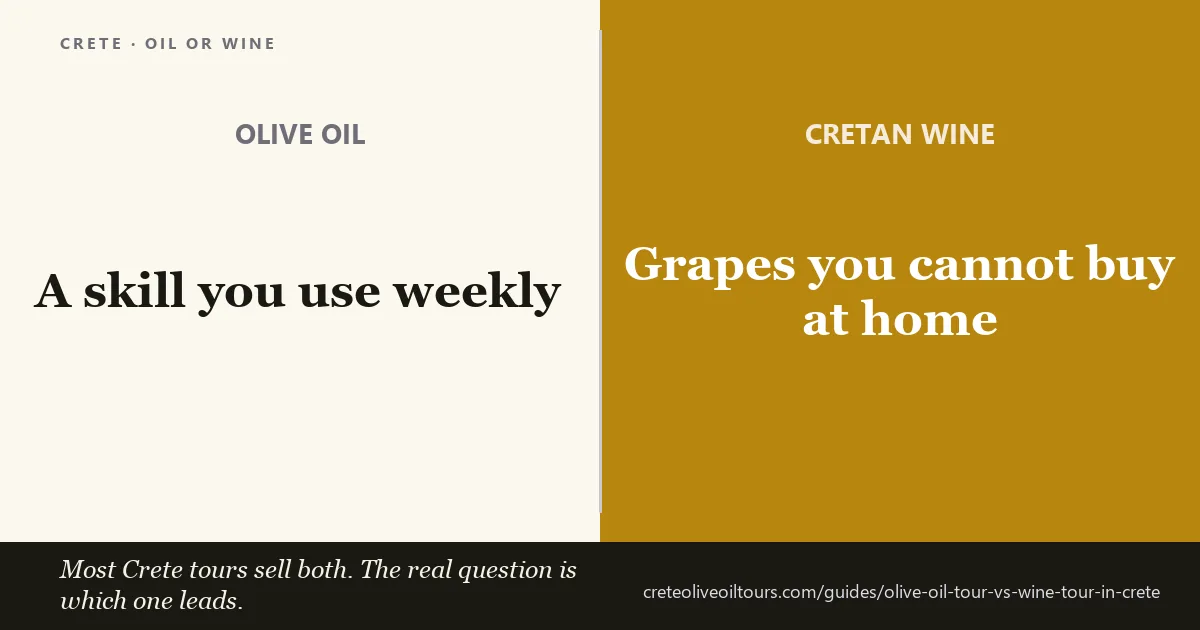
On Crete the question is rarely oil or wine. The same inland valleys grow both, have done since the Minoan era, and most operators sell them together — which means the real decision is which one leads, and how much of the day the other gets.
Get that wrong and you spend $137 on a day that is two-thirds wineries when you came for the mill, or the reverse. Here is how to tell them apart before you book.
Check Availability
Why they come bundled
Olives and vines want the same things: sun, poor stony soil, and a dry summer. In central Crete the Peza, Skalani and Archanes country south of Heraklion has been planted with both continuously since the Bronze Age, and in the west the Kissamos hills behind Chania do the same. A producer who makes oil very often has a cousin who makes wine ten minutes down the road, and the tour operators route accordingly.
So a “wine and olive oil tour” is not a compromise product. It is what the landscape actually is.
The three real shapes
Oil-led, with no wine at all. Two tours on this site. Terra Creta is one hour in a working Kolymvari mill with a three-oil tasting, $11. The Amari Valley tasting near Rethymno is three hours, four oils and a four-course pairing menu, $108. If oil is the reason you are going, these are the only two that give it the whole day.
Balanced, with oil first. The full-day Heraklion tour opens with an olive grove and mill visit and a tasting — roughly an hour — before moving to an organically farmed winery for five wines and a raki distillery built around an ancient stone press. Eight hours, $137, and at 4.97 from 300 reviews the best-rated day on this site. The oil genuinely leads; the wine and raki are the back half.
Wine-led, with a serious oil stop. The Kissamos tour from Chania visits two family wineries and one premium olive oil factory. Six hours, $137. The wine is excellent — award-winning Vidiano and Muscat of Spina, plus Grenache, Syrah and Mourvèdre on Cretan terroir — but two of the three producer stops pour wine, and the balance follows.
The Chania five-producer day at $45 sits slightly apart: oil, wine, cheese, honey and bread, with no single subject dominating. It is the broadest and the cheapest, and the trade-off is depth at every stop.
What each actually teaches you
A wine tasting gives you vocabulary for something you probably already drink. On Crete the interest is the indigenous varieties — Vidiano, Vilana, Assyrtiko, Liatiko — which most visitors have never encountered and cannot easily buy at home. That is the argument for doing it here rather than in Tuscany.
An oil tasting gives you a skill you use weekly. Learning that bitterness is positive, that the peppery throat catch means freshness, and that harvest date beats best-before changes how you shop for the rest of your life. Almost nobody arrives knowing this, and almost everybody uses olive oil.
That asymmetry is the honest case for putting oil first if you can only do one. You will drink better wine elsewhere; you are unlikely to get taught oil this well again. The tasting guide covers what that instruction involves.
The practical differences
Driving. Wine tastings mean someone is not drinking, or you are paying for a tour with a driver. Every combined tour here includes transport for exactly that reason. Oil-only tastings do not have this problem, which is partly why Terra Creta and the Amari Valley experience can get away with expecting you to drive yourself.
Children. The wine stops are the constraint. The Kissamos tour serves under-18s water or orange juice while the adults taste, and two of its three producer stops are wineries — which is a long day for a teenager. Oil and farm tours have no such issue; the Prassas family farm welcomes children from age one.
Season. Wine tasting is identical year-round. Oil is not: the mills press only from about November to February, so a combined tour in July gives you a full wine experience and a static mill. See the harvest guide.
Cost. They converge at the top. Both $137 tours on this site include multiple producers, transport and food. The cheap end belongs to oil: $10 and $11 buys a grove or a mill, and there is no $11 winery day.
So which should you book?
- Oil is the point, you have three hours → the Amari Valley tasting, Rethymno.
- Oil is the point, you have one hour and $11 → Terra Creta, Kolymvari.
- You want both, properly, and oil to lead → the full-day Heraklion tour. Our breakdown →
- You want both and prefer wine → the Kissamos tour from Chania. Our breakdown →
- You want a broad, cheap day covering everything → the Chania five-producer tour at $45. Our breakdown →
- You are not drinking → skip the combined days entirely. A third of what you pay for is alcohol you will not touch. Take an oil-only tasting or a farm visit.
By region: Chania, Rethymno, Heraklion.
Frequently Asked Questions
Can you do a wine and olive oil tour in Crete on the same day?
Yes — it is the most common format on the island, because the same valleys grow both. The full-day Heraklion tour covers an olive grove and mill, a winery and a raki distillery in eight hours, and the Kissamos tour from Chania pairs two wineries with a premium olive oil factory in six.
Which Crete tours are only about olive oil?
Two. Terra Creta at Kolymvari, one hour and $11 for a working mill and three oils, and the Amari Valley tasting near Rethymno, three hours and $108 for four oils against a four-course menu. Everything else bundles oil with wine, food or sightseeing.
Is a Cretan wine tour worth it if I don’t know Greek wine?
That is the argument for doing it, rather than against. Crete grows indigenous varieties — Vidiano, Vilana, Assyrtiko, Liatiko — that are hard to buy outside Greece, so a tasting here introduces you to wines you genuinely cannot try at home.
What if I don’t drink alcohol?
Avoid the combined days. On the full-day Heraklion tour three of the four producer stops serve alcohol, and on the Kissamos tour two of three are wineries — so a significant share of a $137 ticket goes unused. Book an oil-only tasting, a mill visit or a farm walk instead.
Do combined tours include transport?
Yes, and that is largely why they cost what they do. Every wine-inclusive tour here includes a driver, for the obvious reason. The oil-only experiences generally do not, so factor a taxi into their lower prices.
Taste Crete Where the Oil Is Pressed
Mill visits, guided tastings and grove walks across Chania, Rethymno, Heraklion and Lasithi — from $10, with free cancellation up to 24 hours before you go.
Check Availability & Book